
Turin Cathedral (Cathedral of Saint John the Baptist) – Visitor & History Guide
Duomi di Torino. Visitor Guide.
5/2/20265 min read
Key Takeaways
Turin Cathedral, dedicated to Saint John the Baptist, serves as the main church of the Archdiocese of Turin and has been the custodian of the Shroud of Turin for over four centuries.
The current Renaissance cathedral was built between 1491 and 1498 after the demolition of three earlier churches that dated back to the fourth century.
The Chapel of the Holy Shroud, designed by Guarino Guarini, connects to the cathedral apse—though the Shroud is kept in a climate-controlled case and is only visible during rare public displays.
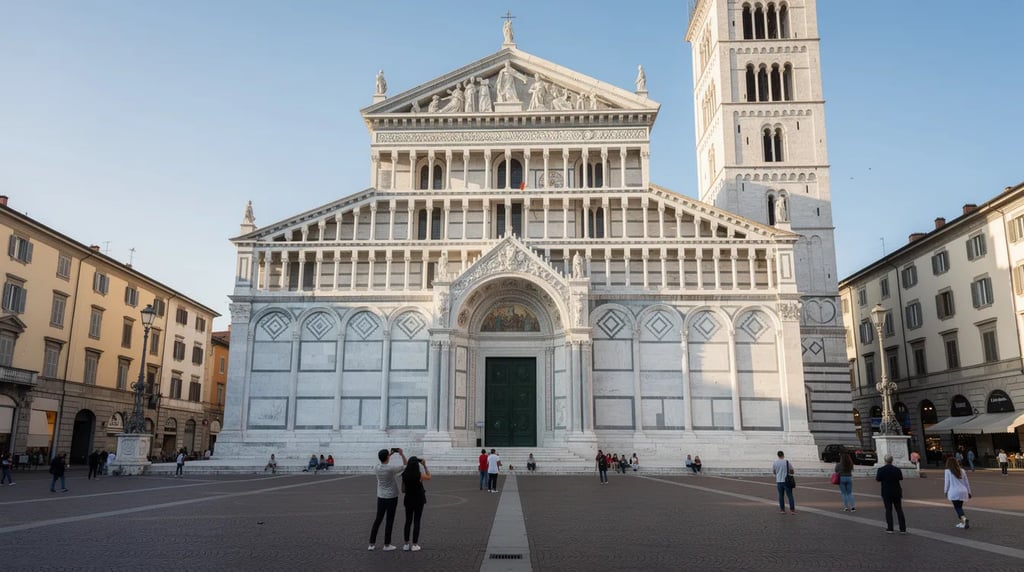
Visitors today can explore the white marble facade, bright Renaissance interior, Guarini dome, bell tower, and artworks, with easy access to the Royal Palace and Palazzo Madama nearby.
The cathedral is located in Piazza San Giovanni with free entrance; confirm current schedules before visiting.
Introduction to Turin Cathedral
The Duomo di Torino, formally known as Cattedrale di San Giovanni Battista, stands as the religious heart of Turin and seat of the Archdiocese. This famous church is best known worldwide for guarding the Shroud of Turin since 1578, when the House of Savoy brought the holy relic to the city.
Located adjacent to Piazza Castello, the Royal Palace, and Palazzo Madama, the cathedral fits seamlessly into any central Turin walking itinerary. The building presents a contrast between its sober, symmetrical Renaissance body and Baroque elements added later, creating a visually distinctive complex that spans centuries of Italian architectural history.
Historical Background of the Site
The site has been sacred ground since the early Christian era. The cathedral stands where three ancient basilicas once served the faithful: one dedicated to Christ the Saviour, one to Saint Mary, and one to Saint John the Baptist. These three fourth-century Christian churches stood side by side near the ancient Roman city walls.
The site was originally part of the ancient Roman city of Julia Augusta Taurinorum, reflecting Turin’s transition from pagan settlement to Christian center. The baptistery dedicated to John the Baptist gradually gained prominence over the centuries. By the late 15th century, Bishop Maximus and church authorities decided to replace all three structures with a single, larger new cathedral befitting the House of Savoy’s rising power in northern Italy.
The cathedral houses archaeological remains of three 4th-century Paleo-Christian churches in the Diocesan Museum located beneath it, preserved for visitors interested in this layered history.
Rebuilding of the Cathedral (1491–1498)
The construction of the current cathedral was commissioned by Cardinal Domenico della Rovere, who was the bishop of Turin at the time. Domenico della Rovere resided in Rome as a nephew of Pope Sixtus IV, wielding considerable influence and resources.
He entrusted the project to Amedeo da Settignano, known as Meo del Caprino (also called Meo del Caprina), a Tuscan architect trained in Florentine Renaissance principles. The new building rose remarkably fast—completed between 1491 and 1498—with the first stone laid by Blanche of Montferrat. The cathedral was consecrated in 1505, and remarkably little of the exterior has changed since, apart from later Baroque additions at the rear.
Architecture and Interior Features
The Turin Cathedral features a blend of Gothic and Renaissance architectural styles, with its construction completed in the late 15th century. The cathedral features a bright white marble facade that contrasts with the red brick traditionally used in the region—a clear Tuscan import to Piedmont.
The church follows a traditional Latin cross layout with three naves, separated by arcades that create a harmonious, luminous space. The interior of the cathedral is filled with smaller chapels decorated by Italian artists from the 16th to 19th centuries. Above the main altar, visitors find devotional art and carved reliefs, while a massive oil-on-wood copy of The Last Supper by Leonardo da Vinci can be found above the main entrance.
The cathedral is renowned for its stunning stained glass windows, which are significant elements of its interior design. The atmosphere remains relatively simple compared with some Italian cathedrals—balanced between Renaissance clarity and later decoration.
Chapel of the Holy Shroud and the Bell Tower
The Chapel of the Holy Shroud was designed by master Baroque architect Guarino Guarini and built between 1668 and 1694. In the 17th century, plans were made to expand the cathedral to store and display the Shroud of Turin, resulting in this extraordinary Guarini Chapel connecting the cathedral apse to the Royal Palace.
The architectural design of the Turin Cathedral includes a prominent dome, which is a characteristic feature of Renaissance architecture. The dome of the Chapel of the Holy Shroud is a self-supporting structure made of intersecting arches that create an optical illusion. The Chapel of the Holy Shroud features a unique dome that creates a tunnel effect toward the light, surmounted by windows that sculpt dramatic beams into the space.
A devastating fire heavily damaged the Chapel of the Holy Shroud in 1997, but emergency responders saved the Shroud. After extensive restoration, the chapel reopened in the 2010s with its Baroque splendor recovered and preserved.
The cathedral has a Romanesque bell tower separate from the main building that offers panoramic views from the top. The bell tower was built in 1470 and later modified by Baroque architect Filippo Juvarra in 1720, dedicated originally to Saint Andrew. This red-brick campanile stands 63 meters high and remains visible across Turin’s skyline.
The Shroud of Turin: History and Display
The Shroud of Turin is a linen cloth bearing the faint image of a man, venerated by many as the burial shroud of Jesus Christ. The Shroud of Turin was brought to Turin in 1578 by the House of Savoy, and the cathedral has served as its home ever since.
Key historical dates include scientific examinations—most notably the 1988 radiocarbon dating—and major public ostensions in 1978, 2000, 2010, and 2015. The Holy Year 2000 display under Pope John Paul II drew millions of pilgrims from around the world.
The Shroud is kept in a climate-controlled case and is only visible during rare public displays. On ordinary days, visitors see only reproductions, photographs, and informational panels. Public exhibitions are announced well in advance by the Archdiocese, often coinciding with jubilees, and typically require reservations.
Visiting Turin Cathedral: Practical Information
Visiting is straightforward thanks to the cathedral’s central location in Piazza San Giovanni, within walking distance of Palazzo Madama, the Royal Palace, and the Egyptian Museum. Opening hours typically run mornings and afternoons with midday closure—confirm current schedules via the diocesan website.
Entrance to the main cathedral is free. Visitors must cover their shoulders and knees when entering the cathedral as it is an active place of worship. Maintain silence during Mass and respect posted photography restrictions near Shroud exhibits.
The cathedral holds the tomb of St. Pier Giorgio Frassati, an important pilgrimage site for many visitors.
Turin Cathedral in the Context of the City
The cathedral anchors a broader exploration of Turin’s historic center. Pair your visit with the Royal Palace complex, Palazzo Madama, and the medieval district around Via Garibaldi. Many guided tours and hop-on hop-off routes include commentary about the cathedral and Shroud.
The square and cathedral are especially atmospheric during major religious feasts—Easter, Corpus Christi, and the feast of Saint John the Baptist on June 24—when special liturgies and city celebrations take place.
FAQ – Turin Cathedral and the Shroud
Do I need a ticket to enter Turin Cathedral?
Entrance to the main cathedral body is free. Special exhibitions, guided tours, or combined tickets with other buildings in the Royal Palace complex may require separate booking.
Can I see the Shroud of Turin during a normal visit?
No—the original Shroud remains in its protective reliquary and is not on open display. Visitors see reproductions and informational panels. Official ostensions occur rarely and require advance reservations.
How much time should I plan for a visit?
Most visitors spend 30–45 minutes inside the cathedral, extending to 60–90 minutes if exploring the last chapel, the Guarini Chapel, nearby museums, and taking photographs in Piazza San Giovanni.
How do I get to Turin Cathedral using public transport?
Several tram and bus lines stop around Piazza Castello and Via Roma. The cathedral is about a 10–15 minute walk from Porta Nuova railway station and easily reachable on foot within the historic center.
© Torinocard.org 2026. All rights reserved.
Privacy Policy. Terms and Conditions.
This website is an independent guide created by history lovers and local Turin experts. Please note that this is not the official website of the Torino City Card. Our mission is to provide high-quality information, historical context, and logistical support for visitors in Turin.
We take pride in only recommending and selling 100% official and authorized tickets sourced through licensed primary and secondary providers. By booking through our links, you ensure a valid entry into the monument. To support our local research and the maintenance of this guide, we may earn a small affiliate commission from your purchase.
🔒 Secure 256-bit SSL Encryption — Your data is protected by the highest 2026 security standards.
🤝 Official Authorized Partner — We only provide 100% valid, official city cards.
📱60-Second Digital Delivery — Get your voucher instantly on your smartphone. No printing required.
🇪🇺 GDPR & LOPD Compliant — We respect your privacy and the European data protection laws.